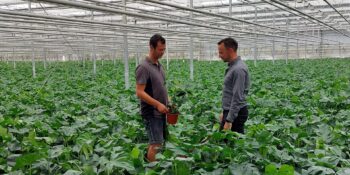
At Stolk Flora, sustainability runs through the veins. The company has been growing Phalaenopsis in 12 cm pots at two sites – in Bleiswijk and Bergschenhoek – since the year 2000. “We lead the way when it comes to sustainability,” says Managing Director Koen van Koppen. “In 2016, we launched this to the public under the name Your Natural Orchid, but way before this we were already using natural predators and biological substances.”

Koen van Koppen, Managing Director
Jan Stolk, namesake and proprietor of the company, was motivated early on to move away from chemicals in the cultivation process. But the company is doing lots more in the field of sustainability, continues Van Koppen: “We’re making our packaging more sustainable, for example, by not packing the orchids in sleeves but using a paper wrapper. We also use shorter and thinner sleeves, meaning 20 percent less material is used.”
The company is not alone in taking these steps. “With Orchidee NL, we look for possibilities as a sector to set targets for reducing packaging material. Within the sector, we’re also looking to keep reducing the footprint a little each year.” They are also taking the necessary steps within the company: “We use LED lighting and an e-boiler. We invest in solar panels to be self-sufficient in electricity and now use dehumidification to heat less. We’re taking steps all the time.”
 Virtually organic
The ‘Your Natural Orchid’ label denotes the virtually organic cultivation method of Phalaenopsis at Stolk Flora. Virtually, since the designation ‘organic’ also stipulates the use of organic fertiliser. No easy thing, realises Van Koppen. “No one has succeeded yet in growing a truly good quality Phalaenopsis using organic fertiliser.”
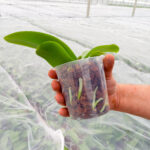 Planting in mosquito net
Apart from that, you could describe cultivation as organic, thanks in part to the use of green products. “The pot worm poses a challenge here. We now keep this under control by growing completely under netting. Above and beneath every bench we have fitted a kind of mosquito net. The plants get fully wrapped and the mosquito is no longer able to reproduce. As a next step, we will use potweb so we can wrap plants per pot.”
Demonstrate what you do well
With this focus on sustainability, it is no wonder that Stolk Flora carries various MPS certificates. “Certifications such as MPS-ABC, MPS-SQ, MPS-GAP and MPS-ProductProof prove that what we say is also independently corroborated. We can show this to our customers, but also use it at open days to illustrate where our company stands in relation to the rest of the sector.
Consumers in particular are placing more emphasis on certifications, notes Van Koppen. “With the CSRD legislation we find that customers also ask more questions about what their suppliers are doing when it comes to sustainability. I hear from customers that their share is a small part of the whole; the producer in particular has to do things right in terms of sustainability. Therefore, the more you can showcase, the better. MPS is a stable player that helps us in this process, especially now customers have a better understanding of what the certificates mean.”