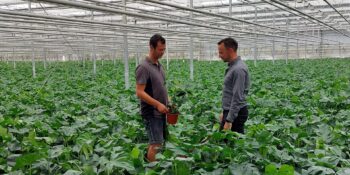
Last month, our Area Manager Maik Mandemaker travelled to Denmark to meet our local MPS-ABC participants, to update them on developments over the past and coming year and to exchange information and ideas.
This meeting was part of the Danish grower’s meeting that is held once every year. All Danish MPS participants are invited to this meeting regarding MPS and sustainability. This year the meeting was arranged by the association Flora Dania (Danish Ornamental Plants). The subject for the meeting was news from MPS, and the relevance of a CO2 footprint and Life Cycle Analysis (LCA) from a retailer’s point of view.
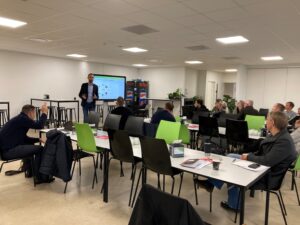 The meeting started with an informative presentation from Maik Mandemaker on optimalisations in the MPS-ABC record keeping environment and on the reliability index score (RI-score) impact. Maik also explained the reasons for implementing the RI-score and the benefits of it.
Maj Schøler Fausing, Head of Strategy at Plantorama A/S, gave a speech on sustainability and LCA and told how the Danish retailer Plantorama looked at the future and the demand for LCA’s, carbon footprint and sustainability. She pointed out that Plantorama, according to the law, will be required to publish detailed information on sustainability matters. In 2025 Plantorama must deliver an LCA/CO2 footprint in relation to scope 3 and this demand can only be fulfilled in cooperation with their suppliers and amongst them the Danish growers.
For the future, Fausing expects that the growers will be meet with requirements on LCA and CO2 footprint calculations. These assumptions were supported by Maik Mandemaker who mentioned that there already are European retailers wanting CO2 footprint calculation. To make it possible for the growers to fulfill the requirements for CO2 footprint calculation, MPS and their partner LetsGrow.com developed the HortiFootprint Calculator. Mandemaker explained that most of the data that are necessary for the HortiFootprint Calculator can be collected from the MPS-ABC record-keeping and only data regarding pots, packing and transportation has to be added to the HortiFootprint Calculator. For a MPS-ABC participant it takes only few more record-keepings to be able to calculate the CO2 footprint of the company.
All in all, it was a very informative and interesting meeting for both MPS and growers. We’ll see you all again next year!
If you would like to know more about the HortiFootprint Calculator or would like to request a demo, please go to the HortiFootprint Calculator website.