MPS-ABC works with an environmental indicator system for the recording of crop protection agents. In this MPS environmental indicator system, active substances are classified into ‘white’, ‘green’, ‘amber’ and ‘red’ categories. White active ingredients have the least impact on the environment. Current company audits and initial audits have revealed that there is some ambiguity about the substances that should be recorded as part of the MPS-ABC record-keeping.
As part of the MPS-ABC record-keeping, you must record all crop protection agents that you use for optimal production.
Some examples besides the ‘regular’ pesticides are:
– disinfectants;
– wetting agents/adhesives;
– chalk preparations for greenhouses and chalk cleaners for greenhouses;
– biological control agents;
– plant enhancers;
– herbicides.
Recording of fertilisers
In addition to the fertilisers that are supplied via the A and B containers, you must also record all other fertilisers. Examples of this are the fertilisers that are added to the potting soil by a supplier, such as PG mix and Dolokal. Fertilisers applied by third parties and contractors must also be stated in the declaration. Examples include organic fertilisers that are applied to fields, such as manure or compost. These fertilisers can be imported as ‘compound fertilisers’.
If a code is missing when recording, you can request it via your Customer portal via ‘Request code’. If you are not sure how to record an agent, please contact Service & Support.
Environmental indicator system
If you want to know which category an active substance falls into, you can look up the coloured dots behind the crop protection agent in the MPS-ABC record-keeping environment.

Each substance is classified into a category, with green being the least polluting and red being the most harmful. A white dot after the product name means that this fabric is neutral and does not count towards the MPS-ABC score. If a product has multiple dots, this says something about how many active ingredients the product contains. If you hover over the dot, you can see which active substance it is.
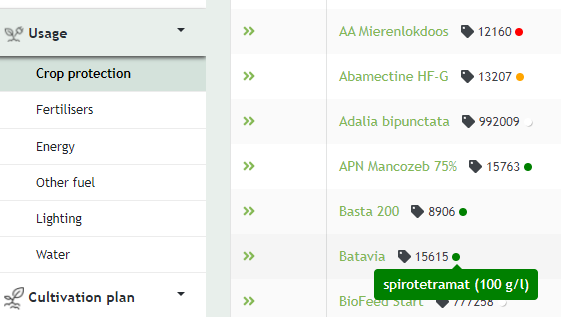
If you don’t see any colours behind the source in the record-keeping environment, you probably selected not to see it. You can adjust this by going to ‘Company Settings’.

Over 30 years ago, my journey at MPS began after I saw an advertisement in the newspaper. After the birth of my daughter, I was looking to return to work and joined the data entry department. At the time, all data was still entered manually from paper forms. Since then, I have seen the organisation grow and change, and I have grown along with it.Today, I work in the Service & Support department. No two days are the same: one day I help a customer with questions about record-keeping, the next I help them understand requirements from the auction or the UO. It is precisely this variety and the personal contact with customers that make my work interesting every day.
In 2008, I joined MPS through a recruitment agency as a secretary. I then held various positions within MPS and MPS-ECAS, including roles in the Service & Support team and as a planner. In 2018, I left the organisation for a while, but in 2023 I returned to MPS-ECAS as a back-office employee. The people are simply too much fun and the world of ornamental horticulture is so innovative that it kept drawing me back. Shortly afterwards, I started working at MPS as Coordinator Netherlands.
During the final year of my Environmental Sciences degree, I joined MPS for an internship. The internship worked out so well for both sides that I was able to stay afterwards. It felt like a natural next step, because I immediately felt at home here and was given the opportunity to continue developing myself.My work is very varied. I work on different projects and products, carry out research and analyses and contribute to practical solutions. I also manage various systems, support customers with complex technical questions and work with external parties. It is precisely this combination that makes my work interesting and ensures that no two weeks are the same.
I first joined MPS through a friend who worked in MPS’s student team. I continued working here while studying Commercial Economics, and at the end of my studies, in 2004, MPS asked if I wanted to join the organisation permanently. It seemed like a great opportunity, and more than twenty years later, I am still here.No two days are the same, and that is exactly what makes my work so enjoyable. A large part of my week consists of project meetings and translating needs from within the organisation into practical solutions. Thursday afternoon is a regular fixture, which I set aside with a colleague to make MPS 1% better every week. For example, we experiment with AI, build prototypes, improve processes or develop new ideas. The goal is always to work smarter and create more value for colleagues, customers and the organisation.