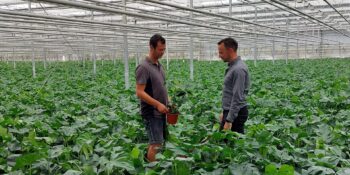
Last month MPS organised an event in France together with Excellence Végétale, an association that promotes certifications in France, where growers could exchange experiences about their cultivation process. The purpose of this was to facilitate discussions between all actions they take to make their production more sustainable.
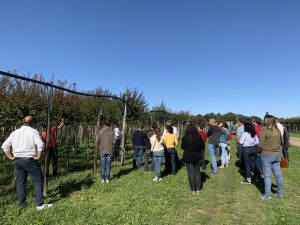
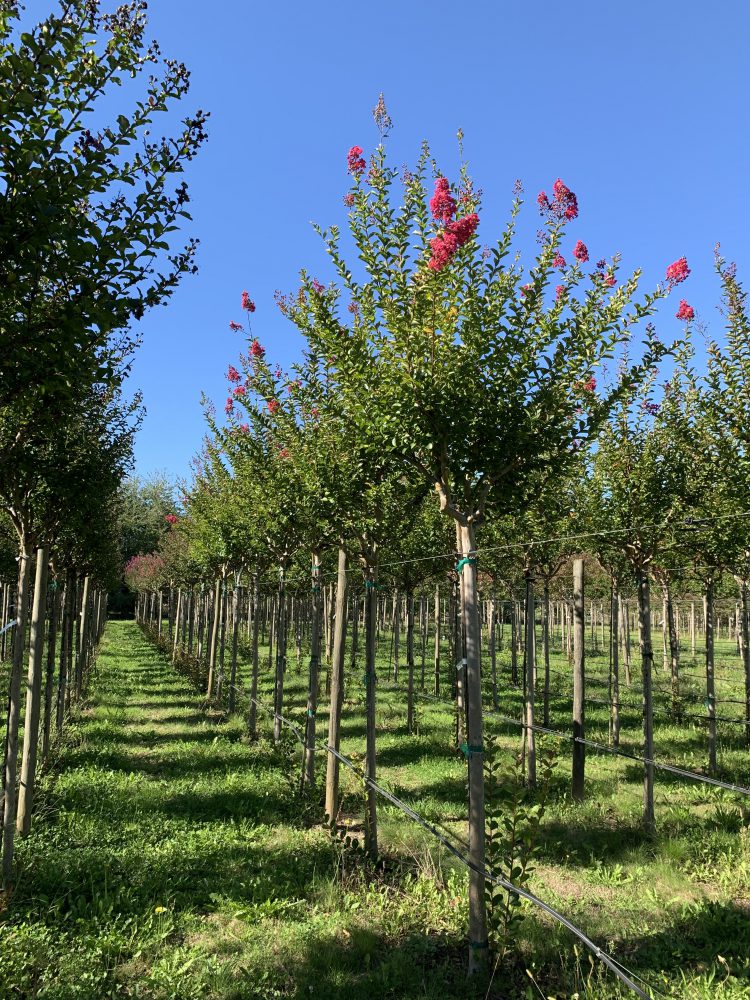
This year’s event took place in Bergerac, at the Pépinières Desmartis company that grows fifty different types of Lagerstroemias, using only crop protection agents when other ways have proven ineffective. This year’s theme was the use of chosen plants against pests on cultivation and the use of chosen plants to develop more biodiversity around cultivated areas.
Advice
Two researchers from the French Horticultural Research Institute, Astredhor, presented the results of their research and experiments on this topic. In addition, they gave growers advice on how to introduce plants that help with their cultivation in their greenhouses or on their fields.
The event concluded with a visit to the company Pépinières Desmartis, which has a brand new three-hectare greenhouse with solar panels on the roof. The company has been MPS-ABC certified since 2003. Pauline Lavidale, responsible for the company’s certificates, says: “Regulations are becoming stricter, it is important to anticipate hierarchically. This way you comply with new rules before they are confirmed. And we think it is important to keep our impact on the environment as small as possible.”
Watchful
The company also uses the MPS-ABC record-keeping for this. “We are vigilant for fluctuations in our score. When we see a fluctuation, we investigate why it is. We do this with a score that has a negative impact on the score, but also the other way around. That’s how we learn from it. In addition, we try to limit as many products as possible that are classified as ‘red’ (these agents are the least environmentally friendly, red.).”

Over 30 years ago, my journey at MPS began after I saw an advertisement in the newspaper. After the birth of my daughter, I was looking to return to work and joined the data entry department. At the time, all data was still entered manually from paper forms. Since then, I have seen the organisation grow and change, and I have grown along with it.Today, I work in the Service & Support department. No two days are the same: one day I help a customer with questions about record-keeping, the next I help them understand requirements from the auction or the UO. It is precisely this variety and the personal contact with customers that make my work interesting every day.
In 2008, I joined MPS through a recruitment agency as a secretary. I then held various positions within MPS and MPS-ECAS, including roles in the Service & Support team and as a planner. In 2018, I left the organisation for a while, but in 2023 I returned to MPS-ECAS as a back-office employee. The people are simply too much fun and the world of ornamental horticulture is so innovative that it kept drawing me back. Shortly afterwards, I started working at MPS as Coordinator Netherlands.
During the final year of my Environmental Sciences degree, I joined MPS for an internship. The internship worked out so well for both sides that I was able to stay afterwards. It felt like a natural next step, because I immediately felt at home here and was given the opportunity to continue developing myself.My work is very varied. I work on different projects and products, carry out research and analyses and contribute to practical solutions. I also manage various systems, support customers with complex technical questions and work with external parties. It is precisely this combination that makes my work interesting and ensures that no two weeks are the same.
I first joined MPS through a friend who worked in MPS’s student team. I continued working here while studying Commercial Economics, and at the end of my studies, in 2004, MPS asked if I wanted to join the organisation permanently. It seemed like a great opportunity, and more than twenty years later, I am still here.No two days are the same, and that is exactly what makes my work so enjoyable. A large part of my week consists of project meetings and translating needs from within the organisation into practical solutions. Thursday afternoon is a regular fixture, which I set aside with a colleague to make MPS 1% better every week. For example, we experiment with AI, build prototypes, improve processes or develop new ideas. The goal is always to work smarter and create more value for colleagues, customers and the organisation.