At MPS, we are happy to help you become more sustainable. Among other things, our MPS-ABC qualification overviews contribute to this, as they give you insight into your usage. As Service & Support sometimes receives questions about these overviews, we will highlight one part of the MPS-ABC qualification overviews per month in the coming period and provide an explanation. You can find your qualification overviews in the Customer Portal, where you can download them at the top right.
The following sections will be explained per month:
- Table 1: Qualification data
- Graph 1-5: Operating usage last year
- Graph 6-9: Operating usage by period
- Composition of points parental material and environmental zones
- Company usage MPS-MIND and MPS-OEX
By facilitating the keeping of your usage records on the environmental themes of crop protection agents, fertilisers, energy, waste and water in the MPS-ABC record-keeping environment, you gain insights into your relative environmental performance compared with growers of similar products under similar production circumstances.
In the qualification and period graphs you will see both qualification data expressed in points as well as usage expressed in kilograms and GJ. Your usage is assigned qualification points: the less you use, the more qualification points you get. This then leads to an MPS A+, A, B or C qualification. In addition, you gain an insight into your usage levels in the form of tables and graphs. Not only does this make your environmental performance transparent, but MPS-ABC also becomes a management tool that helps you to become more sustainable.
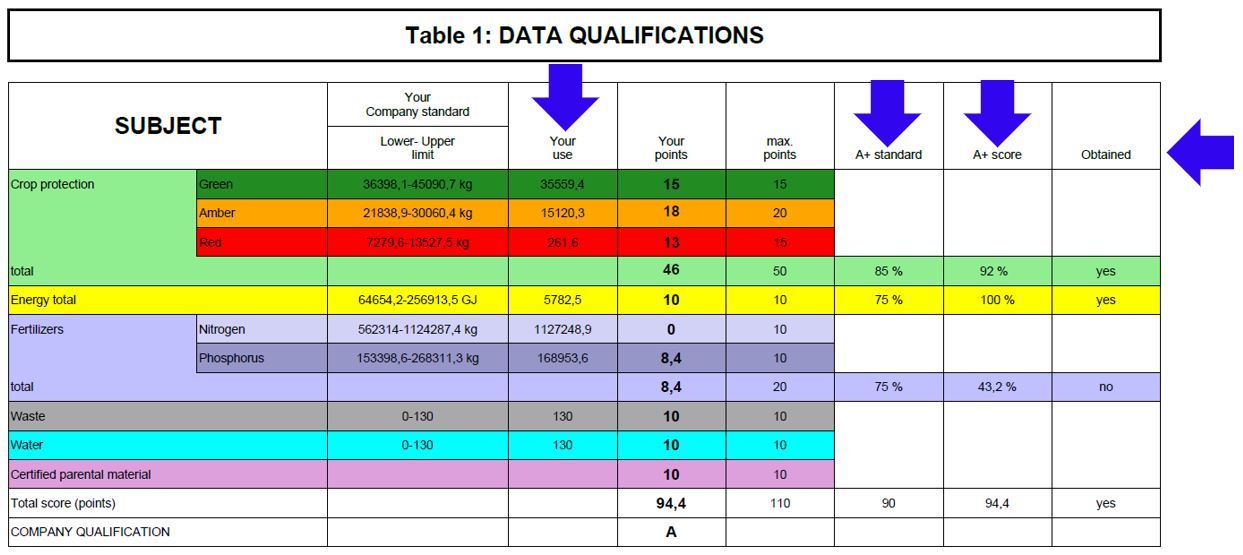
Table 1: Qualification data
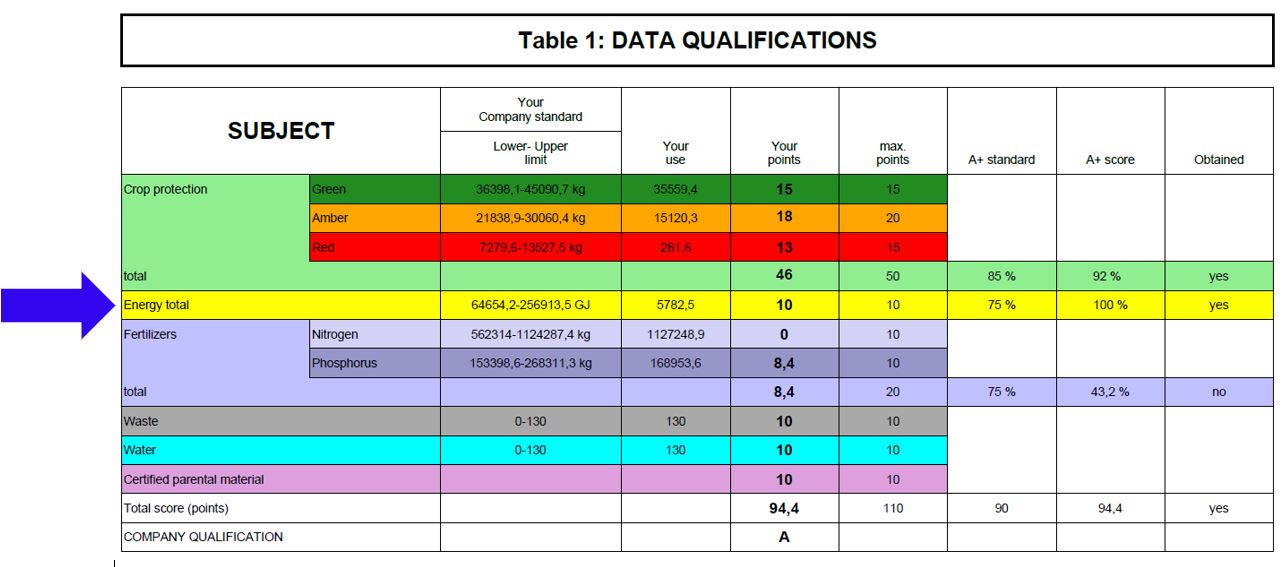
Your company’s qualification data is shown in table 1. The qualification consists of different themes: crop protection, energy, fertilisers, waste, water and certified starting material. In each theme you will find your ‘company standard’: the weighted average of the environmental cluster standards of the crops grown by the company, whereby account is taken of the areas under cultivation and the growing time of the crops.
The lower and upper limits are determined by the average of the bottom 20% of the records with low usage and the average of the top 20% of the records with high usage, respectively, in the same environmental cluster. This allows you to see how you are performing compared with other companies in the same environmental cluster.
Below your usage, you can see the total logged usage for each theme. The less you use, the more qualification points you get. ‘Max. points’ gives the maximum number of qualification points you can score for the theme concerned. The maximum number of points you can score is linked to the country in which your production is located.
A+ standard is the percentage of qualification points that have to be achieved to score A+ for that theme. A+ score is the percentage of the maximum qualification points you have achieved. Under ‘Achieved’ you can see whether you have achieved the A+ score for the theme concerned.
Crop protection total
Crop protection is subdivided into green, amber and red: the MPS-MIND colours. MPS-MIND stands for MPS-Milieu INDicator (MPS Environmental Indicator). This states the risk posed by each active substance to the living environment in which it is used. The effect is determined on the one hand by the chemical properties of the substance, including toxicity, persistence and mobility, and on the other hand by site-specific factors such as its potential for spreading (distribution), environmental factors and the characteristics of the company.

Because these environmental factors are taken into account in the classification, it is possible for an active substance to be classed as ‘red’ in one environmental zone and ‘amber’ in another.
Besides red, amber and green substances, the MPS-MIND method also distinguishes ‘white’ substances. Biological agents and active substances used for pre-treatment (cleaning agents, plant invigorators etc) do not directly affect the participant’s qualification and are therefore classed as ‘white’. However, the use of biological agents often leads to a reduction in the use of green, amber and red agents, so they do have an indirect effect on the number of points achieved. White products are not listed as a theme in table 1.
Energy total
The theme ‘Energy total’ shows your company standard, expressed in the form of a lower and upper limit. After that, your usage is expressed in GJ per year. The points you score based on your usage are shown under ‘Your points’. The maximum number of points you can achieve is given in the column ‘Max. points’. The A+ standard tells you how many points you need to achieve compared with the maximum number of achievable points in order to obtain an A+ score for this theme.
Fertilisers total
Fertilisers are divided into nitrogen and phosphorus. Your company standard is expressed in the form of a lower and upper limit. Your usage is expressed in kilograms per year, followed by your points scored for this theme and the maximum points you can achieve.
Waste
Your usage in the area of waste is not logged. As a grower, you state whether you process your waste responsibly (you will find the definition of ‘responsibly’ in the certification standard). This applies to the following types of waste:
- Responsible processing of organic waste
- Responsible processing of paper
- Responsible processing of plastics
If you state that you process these substances responsibly, you are given the maximum number of points for the theme of ‘waste’.
Water
Records are kept of the quantity of water used under human influence, including the date of the water usage, the quantity and the source from which the water is obtained. At the moment, whether you are assigned points for keeping water records depends on the country in which your company is located.
Certified starting material
Points are assigned for purchases of environmentally certified MPS-ABC and GLOBALG.A.P. starting material. The higher the proportion of environmentally certified starting material, the higher the number of points you will receive for this subject.
If you have questions about the overviews or as a result of this message, please contact Service & Support via +31 (0) 174 – 615 715 or via info@my-mps.com.